


It’s no longer enough to say a building material is designed with sustainability in mind. Owners, architects and contractors want to know the measurable impact of the materials going into a building and how those choices support broader sustainability goals.
Environmental Product Declarations (EPDs) help put those numbers into context. For ATMI Precast, that means giving customers a better understanding of the environmental impact associated with their precast products and a meaningful benchmark for comparison.
What ATMI’s EPDs Measure
ATMI Precast’s EPDs focus on the A1 through A3 stages of a precast product’s life cycle, also known as the cradle-to-gate stages. Those stages account for raw material extraction and processing, transportation of those materials to the manufacturing facility and the manufacturing and fabrication of the precast product itself.
For many clients, the key figure on an EPD is Global Warming Potential (GWP), expressed in kilograms of carbon dioxide equivalent. That number gives project teams a measurable way to evaluate the carbon impact of producing the precast product.
Useful Data, Even Before the Building Is Fully Designed
The challenge with sustainability data is that customers often need it before every project detail has been finalized. ATMI has developed a process that can provide increasingly specific information as the project progresses.
For early conversations, ATMI maintains EPDs for typical insulated wall panel designs that give project teams a representative starting point before a specific building has been fully developed. The current Aurora example covers 9.5-inch insulated wall panels. The A1-A3 GWP value measures approximately 178.8 kg CO₂e per metric tonne.
Click to view full Typical Insulated Wall Panel EPD.
As more project information becomes available, ATMI can create a forecasted EPD by evaluating several of the most common panel types on the project and developing a weighted average to estimate the building’s overall precast GWP.
Once the project is fully designed, ATMI can take that analysis further with a final EPD based on the actual material quantities used in the building.
How Does ATMI Compare?
The Precast/Prestressed Concrete Institute (PCI) has developed regional average EPD data that gives precast producers and their customers a clearer point of comparison. That comparison still has to be made carefully. EPDs are only meaningfully comparable when they follow compatible Product Category Rules, include the same relevant information modules and represent equivalent product requirements and scenarios. ATMI uses the appropriate PCI regional benchmarks to put its own GWP performance into context.
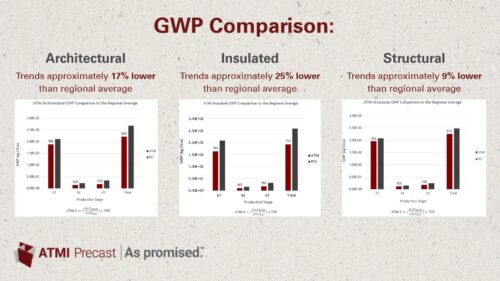
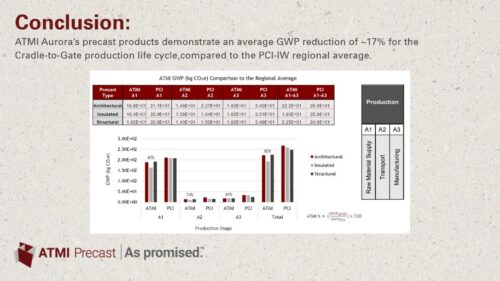
For its Aurora facility, ATMI compares its products to the PCI Illinois/Wisconsin regional averages. The results show:
- Architectural precast trends approximately 17% lower in GWP than the regional average.
- Insulated precast trends approximately 25% lower.
- Structural precast trends approximately 9% lower.
- Across those categories, Aurora’s products average approximately 17% lower cradle-to-gate GWP than the PCI-IW regional average.
ATMI’s Indianapolis facility is compared specifically against PCI Central’s insulated precast benchmark because it produces insulated precast only. The facility’s insulated products demonstrate an average GWP reduction of approximately 37% compared with the PCI Central regional average.
Like any industry benchmark, those comparisons need context. PCI’s product categories encompass a range of precast designs, and individual producers may manufacture different types of products within each category. ATMI’s own benchmarking presentation acknowledges that both product variation and differences in unit design can affect comparisons between a regional average and an individual producer.
The Work Behind a Lower GWP
A major focus behind ATMI’s GWP performance has been concrete mix optimization. Cement is one of the biggest contributors to the GWP of concrete, so ATMI has spent years testing how much cement is truly necessary to achieve the structural performance each product requires. Where appropriate, supplementary cementitious materials, or SCMs, can be used to reduce Portland cement content while supporting long-term strength and durability.
That work predates much of today’s focus on embodied carbon. What began in part as an effort to develop efficient concrete mixes has become increasingly important as customers place greater emphasis on measurable environmental performance.
Today, ATMI continues to evaluate materials, mixes and production approaches with an eye toward reducing GWP without compromising the performance expected from the finished precast product.
Better Information for Better Decisions
As sustainability requirements become more specific, project teams need data they can use with confidence. ATMI’s EPD process gives customers documented, project-relevant information to support material decisions, sustainability goals and reporting requirements.
That clarity becomes increasingly valuable as owners and design teams ask harder questions about embodied carbon and expect measurable answers.